What Are the Top Computer Case Types in 2026?
Choosing a computer case in 2026 is about more than appearance. It affects cooling, noise, component fit, and future upgrades. IDC reported that worldwide PC shipments reached 262.7 million units in 2024, a 1.0% increase from 2023. That figure describes the broader PC market, not case sales, but it signals a continuing stream of systems to house and upgrade. Valve’s monthly Steam Hardware & Software Survey provides another useful snapshot of gaming hardware configurations. Neither source ranks case designs, so this guide treats market data as context—not proof that one format is best.
Gamers Nexus founder Steve Burke’s case-testing work emphasizes evaluating airflow, noise, and build quality together. That is a practical standard for comparing today’s choices. Small details matter: a mesh front panel, a cramped cable channel, or a glass side panel can change the experience. Some trade-offs are easy to miss. This guide examines full-tower, mid-tower, micro-ATX, and mini-ITX cases, alongside dual-chamber and open-frame designs. It considers cooling, desk space, compatibility, noise, and value, while noting where evidence is limited. There is no universal winner. A roomy case can simplify a build, yet occupy half a desk; a compact case can look tidy, yet leave little space for thick graphics cards. The right choice depends on parts, priorities, and tolerance for compromise.
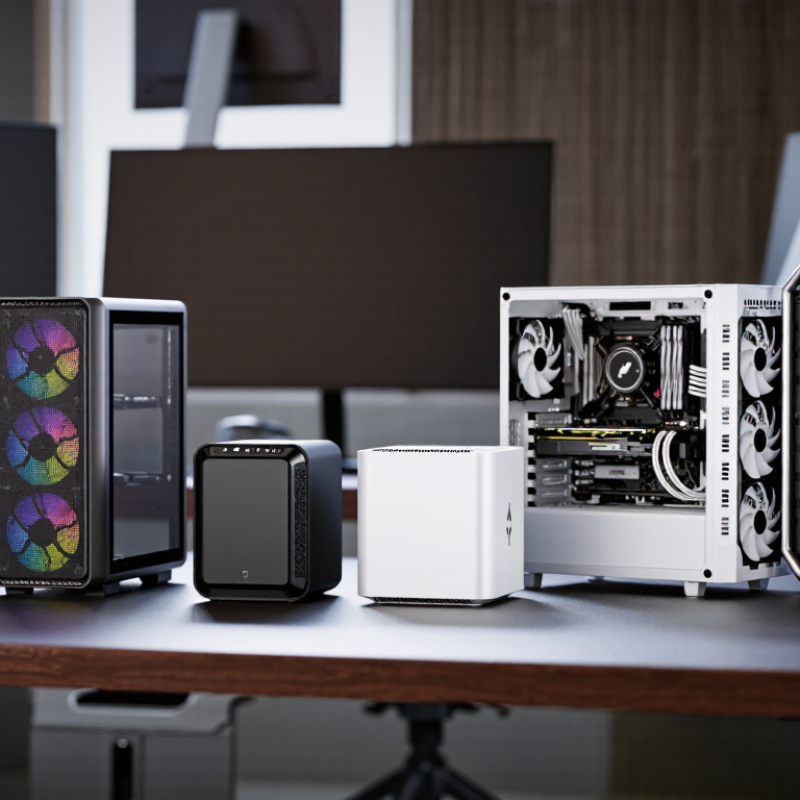
Classify PC Cases by Board Fit: Intel ATX Measures 305 × 244 mm
PC cases are often classified by the motherboard sizes they support. The standard Intel ATX board measures 305 × 244 mm, or about 12 × 9.6 inches. That footprint gives room for full-size expansion slots and familiar component layouts. It also needs a case with matching mounting points and enough interior width. Check the case’s specification sheet, not just its product photos.
A mid-tower commonly accommodates ATX boards, while compact cases may be limited to micro-ATX or Mini-ITX. But “mid-tower” is not a guarantee. Measure the available space around the board area, and check graphics-card length, cooler height, and cable clearance. The board may fit while a thick radiator crowds the top edge. Small details matter.
Standoff positions must match the board’s mounting holes. Never leave an extra standoff beneath the circuit board. This sounds obvious. It is easy to miss during a rushed build. I would also leave room for airflow and future storage, even if the current parts fit neatly. A tight case can look efficient on a desk, then feel frustrating when a fan needs replacing. Dimensions are a useful starting point, not the whole decision.
Full-Tower Cases: Room for Larger ATX Builds and Components
A full-tower case suits builds that need more than standard ATX space: an E-ATX motherboard, a long graphics card, several storage drives, or a large radiator. Extra room can make cable routing and maintenance easier. It also gives hot air more paths to move, though a roomy case cannot fix poor fan placement. IDC’s Worldwide Quarterly Personal Computing Device Tracker reported 262.7 million PC shipments worldwide in 2024, up 1% from 2023. That figure does not measure case size, but it reflects a broad market with varied computing needs—not every build needs a tower this large.
Tips: Check the case’s published GPU length, cooler height, and radiator limits against your parts. Leave space for power cables near the side panel. A few millimeters matter.
Full towers can take up substantial floor or desk space, and their extra volume may make airflow less predictable if fans are poorly arranged. Before buying, sketch your component layout and measure the space where the case will sit. The honest trade-off is that expansion room can feel reassuring, but unused volume is still unused. A full tower makes most sense when the parts list genuinely needs it.
Mid-Tower Cases: Mainstream Support for 305 × 244 mm ATX Boards
Mid-tower cases remain a practical fit for standard ATX builds because they commonly support boards measuring 305 × 244 mm. That footprint follows the ATX form-factor specification. IDC’s Worldwide Quarterly Personal Computing Device Tracker estimated 262.7 million PC shipments in 2024, showing the continuing scale of the PC market. The figure does not predict case sales, but it helps explain why compatibility with widely used desktop components still matters. A mid-tower can offer room for an ATX board without occupying the space of a full tower.
Check the case’s internal clearances, not just its motherboard label. A 305 mm board may fit while leaving little room for front-mounted fans, thick radiators, or cable bends. Measure the graphics card and CPU cooler against the case’s stated limits. Then check how drive cages and cables affect airflow around the board. Small details matter. A tidy build is easier to service, but cable routing can still feel cramped. I would verify the manual’s diagrams before buying; case specifications do not always make clearance obvious.
Compact Cases: Intel Micro-ATX Measures 244 × 244 mm
A Micro-ATX motherboard measures 244 × 244 mm, giving compact cases a clear footprint target. The board itself is small; the finished system still needs room for a power supply, graphics card, cooler, and cable bends. The MicroATX Form Factor Specification defines the board dimensions, but it does not guarantee that every component will fit every case. Check the case’s internal clearances before buying. A few millimetres can matter.
IDC reported 262.7 million PC shipments worldwide in 2024, a 1.0% rise from 2023, in its Worldwide Quarterly Personal Computing Device Tracker. That figure covers computers, not case sales, so it should not be read as proof of a compact-case boom. Still, it shows a large installed market where space-efficient builds can make sense. Look for front intake openings, clear fan positions, and enough space behind the motherboard tray for cables. Small cases can run warm if airflow is restricted. Measure twice. Even a neat 244 mm board may leave awkward gaps, or block a drive mount, in a poorly planned layout.
Compact PC Case Sizes: Motherboard Dimensions
Compare the nominal maximum width and height of three common motherboard form factors, in millimeters.
Micro-ATX measures up to 244 × 244 mm, making it smaller than standard ATX while offering more expansion space than Mini-ITX. Case compatibility depends on the specific case and motherboard.
Small-Form-Factor Cases: VIA Mini-ITX Measures 170 × 170 mm
A Mini-ITX motherboard measures 170 × 170 mm, a footprint that helps compact cases reclaim desk space. That number describes the board, not the whole computer. The case must still fit a power supply, processor cooler, graphics card, and cables. A few millimeters matter. Check the maximum graphics-card length and cooler height before choosing a case; angled cable connectors can crowd the side panel. Mesh panels and well-placed vents can help airflow, but results depend on component heat and fan layout. A tiny case is not automatically quiet.
IDC’s Worldwide Quarterly Personal Computing Device Tracker reported 262.7 million traditional PC shipments in 2024, about 1% more than in 2023. That figure covers PCs broadly, not Mini-ITX systems specifically. It offers market context, not proof of demand for one case size. For a compact build, prioritize measured clearances, airflow paths, and access to ports. A tape measure beats a product photo. Still, planning can miss something: a thick cable or dust filter may reduce usable room. Leave space for maintenance, and expect tighter assembly than in a mid-tower.