A curved display can make a storefront window, control room, or exhibition stand feel more immersive. But shape alone does not make a product suitable. Global buyers also need to compare brightness, resolution, viewing distance, installation requirements, and long-term service. The right choice depends on where the screen will operate and what viewers need to see.
Details matter. A curved LED wall in a bright shopping center faces different demands from an indoor display in a quiet lobby. Buyers should check pixel pitch, cabinet dimensions, refresh rate, and access for maintenance. Ask manufacturers for clear specifications, warranty terms, sample content, and installation guidance. A polished product page can still leave questions unanswered.
This guide introduces ten curved display manufacturers for international buyers. It offers a starting point for comparing product ranges, customization options, technical support, and experience with overseas projects. A manufacturer’s website may not reveal every practical limitation, so confirm critical details directly before making a decision. Request drawings, test reports where available, and references for similar installations. Check how the supplier handles shipping, replacement parts, and communication across time zones.
No single supplier fits every project. Budget, site conditions, content needs, and local service access can change the shortlist. Even a strong specification can disappoint when installation planning is rushed. Use the profiles that follow to frame better questions, compare evidence, and identify which manufacturers merit closer review.
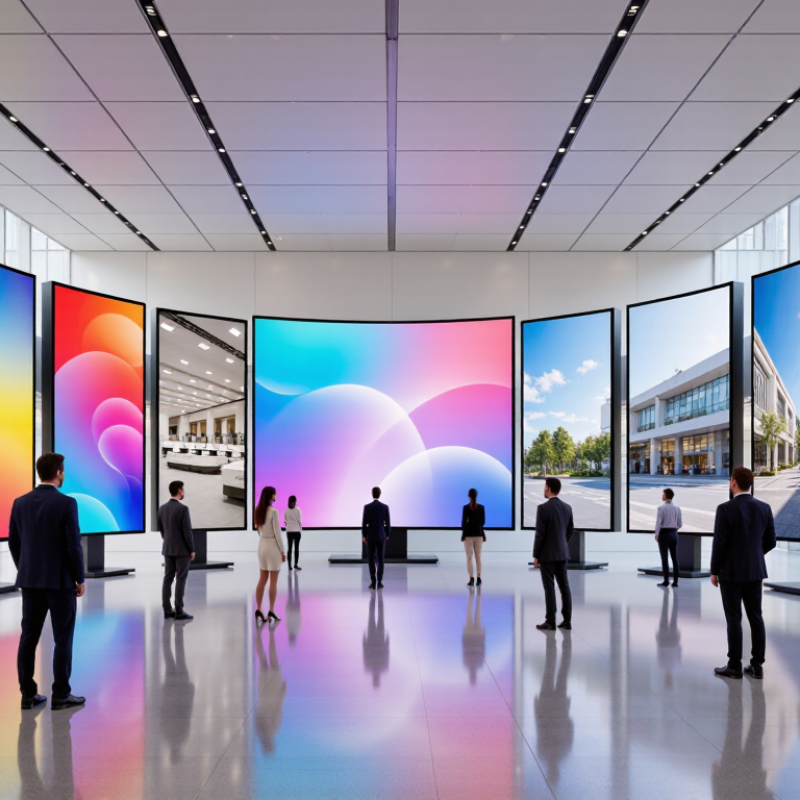
A curved display is a screen whose viewing surface bends along one or more axes. Its curvature is commonly described by radius: a smaller radius means a tighter bend. The shape can bring edge content closer to viewers and create a more continuous image across a wide panel. That matters. It does not automatically improve readability; viewing distance, screen size, and seating position all influence the result. A curve that feels immersive from the center may distort layouts for people standing off to one side.
Design involves more than bending a panel. Engineers must account for the display surface, supporting frame, mounting points, heat, and cable routing. They also check brightness and reflections under real lighting. In a shop window, daylight can wash out dark images; in a control room, several viewers may need consistent visibility. Curved screens also suit exhibition spaces, simulation setups, and digital signage where a broad field of view helps attract attention. One detail is easy to overlook: content designed for flat screens may look stretched near the edges. A prototype viewed at the intended distance can reveal this early. The curve may look striking in a mock-up, yet feel awkward in daily use. That is worth questioning.
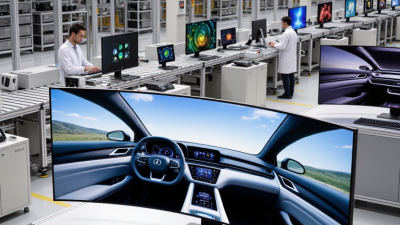
A curved screen is not a separate display technology. It is a shape applied to a panel, and the panel type determines much of its image quality. Curved LCDs use liquid crystals and a backlight; local dimming can improve contrast, but light may still bloom around bright objects. Mini-LED is a backlight approach, not a panel technology. The distinction matters.
OLED panels produce light at each pixel and can use flexible substrates, making curved designs easier to form. They deliver deep blacks, but brightness and long-term image retention depend on materials, settings, and use. For a fair comparison, buyers should check measured performance rather than assume every curved OLED outperforms every LCD. Specifications can hide trade-offs.
A useful reference is VESA’s DisplayHDR certification specification, which includes peak-luminance tiers such as 400, 600, and 1,000 cd/m². These figures help frame HDR brightness, but they do not describe curvature, viewing angles, or uniformity across a bent panel. Ask for test results at the screen’s center and edges. A small caveat: published measurements may not reflect a buyer’s room, and curved screens can show reflections differently under overhead lights. That part is easy to overlook.
A technology primer for global buyers comparing common display architectures.
The chart compares pixel-lighting architecture, not market share or product availability. OLED, QD-OLED, and MicroLED pixels produce their own light; LCD pixels modulate light from a separate backlight. Mini-LED is a backlight approach used in some LCDs, not a self-emissive pixel technology. In the chart, 1 means “Yes” and 0 means “No.”
Evaluating curved display manufacturers starts with the intended installation. A screen viewed from two metres needs different curvature and brightness than a retail wall viewed up close. Ask for the radius in millimetres, pixel pitch, peak brightness, refresh rate, and operating-temperature range. Then request a sample or live demonstration. Inspect text near the edges, colour uniformity across the curve, and reflections under your actual lighting. A polished specification sheet is not enough.
Check how the manufacturer controls quality across production batches. Request test methods, defect limits, burn-in procedures, warranty terms, and spare-part availability. IDC’s Worldwide Quarterly PC Monitor Tracker reported approximately 126 million monitor shipments in 2023. This broad-market figure is not a curved-display forecast, but it shows why consistent production and dependable support matter. Ask for dated inspection records and clarify whether brightness figures describe typical or peak performance. Small omissions here can become costly.
Tips: Compare like with like. Put two samples side by side, use the same video signal, and measure brightness at the centre and edges. Ask who handles calibration after installation. No checklist is perfect; I would still verify the sample against the written specification before approving a large order.
For global buyers, a top-ten curved display manufacturer shortlist should compare engineering and delivery, not just screen size. Check the curve radius, brightness uniformity, viewing angle, pixel pitch, and operating temperature against the installation site. Ask for measured samples and a written tolerance range. A bright showroom image can hide uneven edges. It happens.
Grand View Research’s Curved Display Market Size, Share & Trends Analysis estimated the market at about US$5.6 billion in 2023 and forecast a 6.2% compound annual growth rate from 2024 to 2030. That growth suggests wider demand, but it does not prove that every supplier can support a specific project. Compare production capacity, quality-control records, spare-part availability, and shipping protection. Request test reports for the exact model, not a similar product. Also confirm how the supplier handles failures after installation. This step is often overlooked, even by experienced procurement teams.
Tips: Send shortlisted manufacturers the same specification sheet. Include viewing distance, daily operating hours, ambient light, required curve, and delivery location. Compare total landed cost, not unit price alone. Keep one sample for your own inspection.
Top 10 Curved Display Manufacturers for Global Buyers
Comparing Suppliers by Products, Capabilities, and Service
Choosing a curved-display supplier takes more than comparing screen sizes and quoted prices. IDC’s Worldwide Quarterly PC Monitor Tracker reported 125.3 million monitor shipments in 2023, showing the scale of a competitive market. That figure covers all monitor types, not curved models alone. Buyers should compare panel technology, curvature radius, resolution, brightness, and interface options against their actual use case. Ask for a sample and inspect the curve from the intended viewing distance. Check whether brightness and color remain consistent near the edges.
Manufacturing capability matters just as much as the product list. Request documented quality checks, production lead times, and sample-to-production consistency data. For custom orders, clarify minimum quantities, tooling costs, packaging, and how defects are handled. A supplier may offer an impressive specification sheet yet provide limited evidence of long-term reliability. That gap deserves attention. Service also counts: test response times, access to technical documents, and the process for replacement parts before placing a large order.
Tip: Ask suppliers to provide a dated test report for the exact panel model. Compare dead-pixel limits, operating temperature, and warranty terms in writing. Small details matter. A short pilot order can reveal uneven curvature, fragile packaging, or slow support—problems a presentation rarely shows.
| Profile | Typical Product Focus | Curved Display Technologies | Common Capabilities | Service Considerations | Best-Fit Projects |
|---|---|---|---|---|---|
| 01 — Large-panel display producer | Curved televisions and large-format monitor panels | Curved LCD and OLED formats, depending on product generation and market availability | High-volume panel production; standardized panel sizes and resolutions | Confirm regional warranty coverage, panel availability, and end-of-life notice policies | High-volume consumer electronics and standardized display products |
| 02 — Commercial monitor manufacturer | Curved desktop monitors for office, gaming, and professional use | Primarily curved LCD panels, commonly using VA technology; some product lines use other LCD types | Finished monitor assembly, connectivity integration, enclosure design, and product testing | Check operating-system compatibility, replacement-part availability, and dead-pixel policy | Office deployments, gaming setups, and multi-monitor workstations |
| 03 — Custom LCD module integrator | Curved LCD modules and display assemblies for equipment makers | LCD modules with custom cover glass, touch layers, or optical bonding | Module integration, mechanical adaptation, interface customization, and sample builds | Request interface documentation, engineering-change control, and lifecycle commitments | Industrial equipment, kiosks, control panels, and specialized instruments |
| 04 — Flexible OLED display specialist | Curved or bendable OLED modules for compact and premium devices | Flexible OLED panels; achievable curvature depends on the panel and final device design | Thin module construction, custom form factors, and integration support for device makers | Validate bend radius, lamination process, environmental limits, and sample yield before volume orders | Premium electronics, curved device interfaces, and design-led products |
| 05 — LED display manufacturer | Curved direct-view LED walls and modular display systems | LED cabinets or modules arranged in curved layouts; some systems support flexible or corner configurations | Cabinet design, pixel-pitch options, control-system integration, and project configuration | Confirm installation tolerances, spare-module quantities, calibration support, and service response arrangements | Venues, broadcast sets, retail environments, and large-format installations |
| 06 — Flexible LED solution provider | Lightweight flexible LED modules for non-flat surfaces | Flexible LED panels or modules that can be assembled into curved shapes within specified limits | Custom shapes, mounting-system planning, control configuration, and on-site commissioning options | Request documented minimum curvature, approved mounting methods, and repair procedures | Exhibitions, stage backdrops, architectural features, and creative installations |
| 07 — Digital signage system supplier | Curved commercial screens and integrated signage systems | Curved LCD displays or curved LED systems, depending on screen size and installation needs | Display, player, enclosure, and content-management integration | Evaluate remote monitoring, software support period, security updates, and local technical coverage | Retail, hospitality, transport, and corporate communications |
| 08 — Projection and immersive-display integrator | Curved projection screens and immersive visual environments | Projection onto curved screens or surfaces; the display surface is not necessarily an electronic panel | Screen geometry planning, projector alignment, blending, and calibration | Check installation, recalibration, replacement-lamp or light-source support, and room requirements | Simulation, museums, themed environments, and immersive venues |
| 09 — Automotive display supplier | Curved instrument-cluster and cockpit display assemblies | Curved LCD or OLED modules designed for integration into vehicle interiors | Automotive-grade design processes, optical bonding, environmental testing, and long product lifecycles | Review qualification requirements, traceability, change control, and program-level support | Vehicle cockpit programs and transportation equipment |
| 10 — Custom display project integrator | Made-to-order curved display assemblies across several application types | Project-dependent LCD, OLED, LED, or projection solutions | System sourcing, mechanical design, prototyping, and integration of third-party components | Clarify which components are manufactured in-house, who owns the warranty, and how support is delivered | Low-volume projects, bespoke installations, and multi-component display systems |
These anonymized profiles describe common supplier types and market capabilities; they are not a verified ranking or company-specific audit. Product availability, specifications, lead times, and service coverage vary by model and region and should be confirmed directly with suppliers.