How to Choose the Right Power Supplies for Your Needs?
Choosing the right power supplies can be challenging. It’s essential to consider your specific needs. Power supplies come in various shapes and sizes, each designed for different purposes. For instance, beginners often overlook wattage requirements. Underestimating this can lead to insufficient power, which may damage devices.
When shopping for power supplies, think about efficiency. Higher efficiency means less energy waste. This is crucial for saving on electricity bills in the long run. Also, consider the reliability of the brand. Not all manufacturers produce quality products. Poor choices can lead to unexpected failures, disrupting your work.
Pay attention to compatibility. Ensure your power supply matches your device’s voltage and current specifications. This step is crucial for optimal performance. Remember, a mismatched power supply might cause more harm than good. Reflect on your choices carefully.
Understanding the Different Types of Power Supplies Available
When selecting power supplies, understanding the various types is crucial. Common categories include linear, switching, and uninterruptible power supplies (UPS).
Linear power supplies are simple but inefficient. They convert AC to DC with minimal noise. However, they can generate significant heat and are not suitable for high-power applications.
Switching power supplies are favored for their efficiency. They convert power quickly and generate less heat. Report by the International Electrotechnical Commission (IEC) suggests that switching supplies can achieve efficiencies above 90%. They are suitable for electronics where space is limited. However, they can introduce electromagnetic interference.
Tips: Consider your load requirements. Always leave a margin when choosing a power supply. This helps ensure stability and longevity.
UPS devices provide backup power during outages. They allow devices to keep running and prevent data loss. Yet, these systems can be costly and require regular maintenance. It's important to assess your actual needs before investing in a UPS.
Identifying Your Power Requirements for Specific Applications
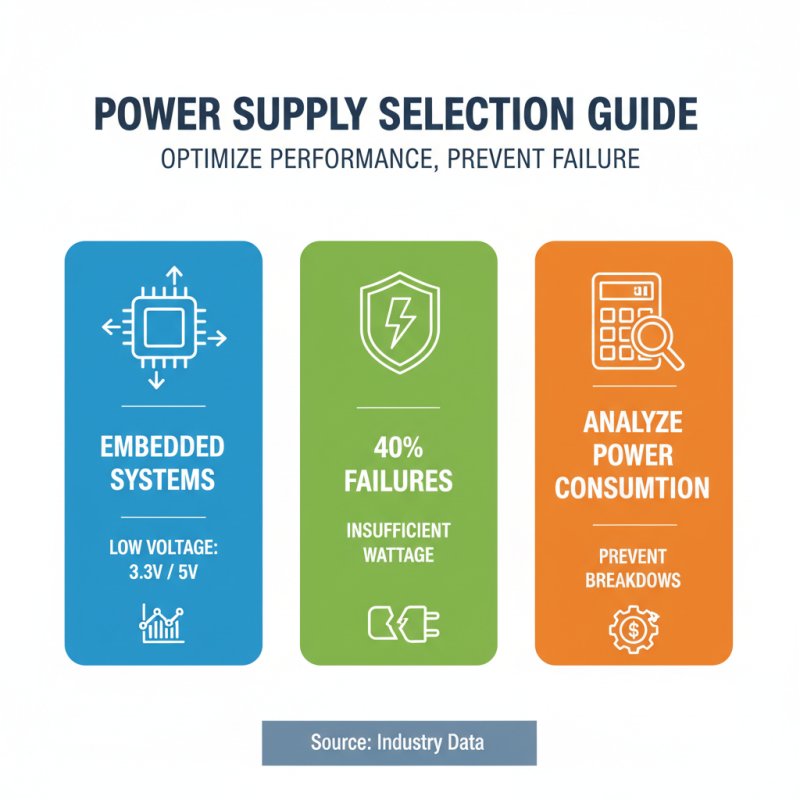
When selecting power supplies, understanding your specific power requirements is crucial. Different applications demand varying voltage and current levels. For instance, embedded systems often require low voltages, typically around 3.3V or 5V. According to industry data, a staggering 40% of power supply failures stem from insufficient wattage. Analyzing the power consumption of components can prevent these costly breakdowns.
For industrial applications, the scenarios can become complex. Motors and heavy machinery usually require high starting currents. In some cases, peak demands can exceed nominal ratings by 150%. This emphasizes the importance of accounting for startup power. Neglecting this can lead to system instability. It's vital to assess both average and peak loads.
Additionally, continuous operation can lead to overheating and reduced lifespan if not properly managed. Cooling solutions are often necessary. Reports indicate that overheating accounts for up to 30% of power supply failures. Ignoring this aspect may seem trivial at first but it can lead to significant performance issues later. Therefore, it's essential to evaluate environmental conditions and choose power supplies accordingly. Aim for a margin over your estimated usage to ensure reliability.
Evaluating Quality and Efficiency Ratings of Power Supplies
When choosing power supplies, focusing on quality and efficiency ratings is crucial. Efficiency impacts energy consumption and cost. Reports indicate that power supplies can waste up to 30% of energy. This wastage not only affects electricity bills but also contributes to increased heat generation. A well-rated power supply can operate at 80% efficiency or higher, helping to reduce these losses significantly.
Quality ratings often reflect the product's durability and performance under stress. A study showed that higher-quality power supplies experience fewer failures over time. Users reported a 50% failure rate for low-end models compared to only 10% for high-quality units. This disparity can lead to additional costs for replacements and repairs. Selecting a power supply with a high reliability rating can minimize long-term expenses.
Moreover, look for certifications like 80 PLUS, which indicate efficiency levels. There are several tiers, including Bronze, Silver, Gold, and Platinum. Each tier corresponds to a specific level of efficiency at varying loads. The market shows that power supplies labeled as 80 PLUS Gold use at least 87% efficiency at typical loads. This data highlights that investing in efficient models pays off in the long run. However, not all models label their tests. Users should be cautious and verify claims before purchase.
Considering Size, Form Factor, and Compatibility Factors
Choosing the right power supply is crucial for many electronic projects. Size and form factor significantly influence your options. For instance, small form factors, such as SFX, are perfect for compact builds. A standard ATX power supply would be unsuitable due to space constraints. According to a recent industry report, nearly 40% of users cite size as the top consideration when buying power supplies.
Compatibility factors are essential too. Ensure your power supply works with all components in your setup. This includes checking voltage requirements and connector types. A mismatch can lead to system instability. The same report highlights that over 30% of users experience compatibility issues, which can complicate configurations.
**Tips:** Always verify PSU specifications before purchase. Use online calculators to determine wattage needs. Consider future upgrades. Don’t ignore feedback or reviews on compatibility. Even products with high ratings can have limitations. Assessing these factors will help you make a better choice.
Power Supply Wattage Comparison
Budgeting for Power Supplies: Cost vs. Performance Considerations
When choosing power supplies, budgeting is crucial. Cost often influences performance. It’s easy to fall for flashy specifications. However, not all high-cost options guarantee efficiency or reliability. You might want to spend a little extra, but you should consider what you truly need.
Think about your specific requirements. If you have a modest setup, premium features may be unnecessary. Picking a power supply with the right wattage is essential. Sometimes, individuals overestimate their needs, leading to overspending. Meanwhile, some might opt for the cheapest option, which can result in issues later on. Balancing cost and performance is vital.
A thorough assessment of your projects will guide you. Check energy consumption ratings and reviews. Dive deep into the specs, rather than glossing over them. Ask yourself: Does this fit my budget? What sacrifices am I making for lower costs? In this way, careful planning can help align your choices with both budget and desired performance.
How to Choose the Right Power Supplies for Your Needs? - Budgeting for Power Supplies: Cost vs. Performance Considerations
| Power Supply Type |
Cost ($) |
Wattage (W) |
Efficiency (%) |
Performance Rating |
| Standard ATX |
50 |
500 |
80 |
Good |
| High-Efficiency ATX |
75 |
600 |
90 |
Excellent |
| Modular ATX |
85 |
700 |
88 |
Very Good |
| SFX Compact |
65 |
450 |
80 |
Good |
| Industrial Power Supply |
150 |
1000 |
85 |
Very Good |