Leave Your Message

China Top 10 AIO Copper Radiator Manufacturers

Aio Copper Radiator design remains a practical choice for PC builders seeking efficient heat transfer in compact systems. Copper’s high thermal conductivity helps move heat from the cold plate into the radiator, where thin fins and fans release it into the air. Yet material alone does not guarantee strong cooling. Pump quality, fin density, coolant pathways, fan noise, and long-term reliability all matter.

The International Energy Agency’s Electricity 2024 report estimates that data centers used about 460 terawatt-hours of electricity in 2022. In its high-growth scenario, consumption could exceed 1,000 terawatt-hours by 2026. This is not a direct forecast for desktop liquid coolers, but it shows why thermal management is receiving wider engineering attention. Small details count.

This guide to China’s top 10 AIO copper radiator manufacturers focuses on the evidence buyers can check: product specifications, documented testing, manufacturing experience, compatibility, warranty terms, and support. A factory photograph or a claimed cooling capacity is not enough; test conditions should be clear. Comparisons are imperfect, because brands may use different processors, room temperatures, and fan settings. That deserves scrutiny. The list is intended as a starting point, not a universal ranking, and readers should confirm current specifications directly with each manufacturer.
China Top 10 AIO Copper Radiator Manufacturers

AIO Copper Radiator Basics: Copper Conductivity of About 401 W/m·K

An AIO copper radiator uses copper’s high thermal conductivity to move heat from coolant toward the fins. At room temperature, engineering references such as the Copper Development Association’s material-property tables place pure copper near 401 W/m·K. That figure describes the material, not the cooling capacity of a complete radiator. Not magic.

In a real unit, heat crosses tube walls, joints, and fin surfaces before airflow carries it away. Each interface adds resistance. Copper’s conductivity is roughly 1.7 times aluminum’s commonly cited value of about 237 W/m·K, but fin area, airflow, coolant flow, and manufacturing quality also matter. A dense fin stack may look impressive, yet restricted airflow can limit heat removal. I would not treat 401 as a performance guarantee; it is easy to overread one number. For buyers comparing manufacturers, ask for test conditions, coolant temperatures, and fan speeds alongside material specifications. Those details make results more useful—and more honest.

China’s Top 10 AIO Copper Radiator Manufacturers: Profiles and Capabilities

China Top 10 AIO Copper Radiator Manufacturers

China’s Top 10 AIO Copper Radiator Manufacturers: Profiles and Capabilities

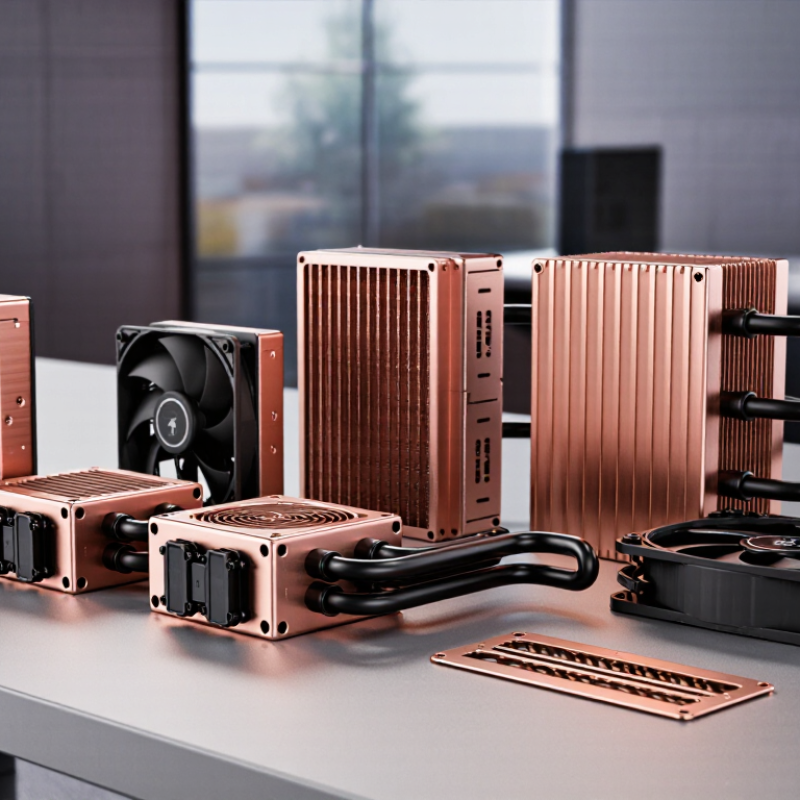
China’s AIO copper radiator suppliers vary in their strengths. Some emphasize OEM production and flexible configurations, while others specialize in copper cold plates, fin assemblies, or complete liquid-cooling units. A useful supplier profile should explain its manufacturing scope, quality controls, customization options, and experience with different radiator sizes. Look for clear technical details, not broad claims.

Capabilities matter at the component level. Ask how copper plates are formed and joined, how fin spacing is controlled, and which leak checks are performed. Request material specifications and sample test records when available. Thermal results depend on more than copper alone; pump performance, coolant flow, fan setup, and installation also matter. A polished product sheet is not proof. It is only a starting point, and even experienced buyers can overlook small fit or noise issues.

Tips: Compare samples under the same workload and ambient temperature. Check dimensions, connector placement, and tube flexibility before ordering. Ask how defects are recorded and handled. Keep the questions specific.

Radiator Formats Explained: Common 120, 240, and 360 mm Sizes

AIO radiator sizes usually describe fan layout, not the radiator’s exact length. A 120 mm model fits one 120 mm fan; 240 mm uses two, and 360 mm uses three. The number refers to nominal fan size. End tanks add extra length, so measure the case’s mounting area before buying. Check the case first.

A 120 mm unit suits compact builds and moderate heat loads, but can require faster, noisier fan operation. A 240 mm radiator offers more surface area for many mainstream systems. A 360 mm model can move more heat at lower fan speeds, if the case has room. Performance is not guaranteed by size alone: radiator thickness, airflow, fan speed, and CPU power all matter. Leave clearance for memory modules and motherboard heatsinks, too.

MarketsandMarkets’ 2024 Liquid Cooling Market report projects growth from US$2.8 billion in 2024 to US$7.8 billion by 2029. That broad market figure includes applications beyond desktop AIOs; it does not compare 120, 240, and 360 mm radiators. Treat it as industry context, not proof that a larger cooler will suit every build. I still double-check. Radiator dimensions and mounting clearances vary, and a millimetre can matter.

How Copper Radiators Are Made: Tubes, Fins, Brazing, and Leak Tests

China Top 10 AIO Copper Radiator Manufacturers

How Copper Radiators Are Made: Tubes, Fins, Brazing, and Leak Tests

Copper radiator production starts with tubes formed to controlled diameters and bends. Even small variations can disrupt coolant flow or complicate assembly. Fins are stamped from thin metal strips, then attached to the tubes to increase the surface area exposed to air. Copper Development Association technical data lists C11000 copper conductivity at about 226 Btu/(h·ft·°F), or 391 W/(m·K). That is a material-property benchmark, not a guarantee of radiator performance; fin spacing, airflow, and joint quality matter too. Small details matter.

During brazing, heat and filler metal join tubes to headers and other components. Operators must control joint clearance, cleanliness, and heating time; excessive heat can distort parts, while poor wetting can leave hidden defects. A shiny bead proves little. After cooling, manufacturers check dimensions and inspect joints before leak testing. Pressure-decay or tracer-gas methods can reveal leaks that visual checks miss; ISO 20485:2017 describes tracer-gas leak-testing methods. Test pressure and acceptance limits should follow the radiator’s design requirements. Recording results helps trace failures, though one test alone cannot prove long-term durability. A careful process still needs review.

Copper Radiator Manufacturing: Material Thermal Conductivity

At approximately 20°C, pure copper conducts heat at about 401 W/(m·K), compared with about 237 W/(m·K) for pure aluminum. Radiator production commonly involves forming tubes, stacking fins, brazing joints, and leak testing the finished assembly.

How to Compare Manufacturers: Thermal Performance, Quality Control, and OEM Support

When comparing China’s top 10 AIO copper radiator manufacturers, request thermal results from a controlled test, not a single peak-temperature claim. Copper’s thermal conductivity is about 401 W/m·K, according to Copper Development Association material data. That helps explain its use in heat-transfer paths, but it does not prove a complete cooler performs well. Ask for coolant temperature, ambient temperature, fan speed, noise level, and heat load. Compare results under identical conditions.

Small details matter. Check fin spacing, tube joints, pump consistency, and cold-plate flatness. Request batch-level leak-test records and inspection procedures, not just a quality certificate. ASHRAE’s 2021 Thermal Guidelines give an 18–27°C recommended inlet range for Class A1 equipment; while this is not a PC-cooler rating, it underlines why test conditions must be stated. A one-degree room difference can distort close comparisons.

OEM support deserves equal scrutiny. Ask whether the supplier can provide drawings, sample revisions, packaging options, and a named engineering contact. Confirm how design changes are logged and how defects are traced by production lot. Get a written sample schedule and change-control process. It sounds mundane. It saves rework. One caveat: published data may not reflect your chassis, airflow, or installation, so validate samples in the intended build before approving volume orders.